TODAY
DECISION-ZONE | INTENT • CAUSALITY • CONTROL
RUNTIME COMPUTING
THE WORLD’S ONLY RUNTIME COMPUTING TECHNOLOGY
Software executes what was decided earlier.
Decision-Zone computes what is required now.
Powered by Triadic Causal Programming, Decision-Zone independently computes what a human-defined mission requires, what available Actors can accomplish, and what actions are admissible under human-defined authority and current causal reality.
Any intelligence. Any actors. One governed reality.
EXPLORE RUNTIME COMPUTING READ THE ROGUE AI PAPER READ THE MISSION COMPUTING PRIMER READ THE INVISIBLE COMPUTATION READ THREE REALMS READ THE ARCHITECTURAL PAPER EXPLORE LIVE DEMONSTRATORS ALL PAPERS AND PRIMERS
Runtime ComputingThe technologyTriadic Causal ProgrammingThe architectureMission AutonomyThe result
THE HUMAN MISSION
Runtime Computing — The Film
The human mission as the foundation of safety, security, control and continuance.
From a human inside the machine’s loop to the machine inside the human’s mission.
WATCH THE FILM 1:36 · Narrated film · Public access
RUNTIME COMPUTING
Safe, Continuous Autonomous Control of Digital and Physical Systems.
Runtime Computing makes the continuing mission computational. Through independent Requester, Actors and Governor computations, Decision-Zone determines what is required, what is possible and what is admissible in current causal reality.
Only admitted actions cross the Commit Boundary. Observed consequences return to the same mission, enabling continuous adaptation and mission continuity while supporting safety and security within human-defined authority, invariants and constraints—even as AI agents, autonomous systems and cyber threats evolve.
THE TRANSFORMATION
AI made the Actor intelligent.Runtime Computing makes the mission computable.
WITH DECISION-ZONE
Intelligent Actors.Computable missions.
Three independent computations:
- Requester
- Actors
- Governor
Humans define purpose and authority. Machines compute the continuing mission.
Governed execution. Runtime control. Mission continuity.
 ACTUAL FIRST PAGE · COMPLETE 14-PAGE PDF
FLAGSHIP ARCHITECTURAL PAPER | OCTOBER 2026
YOUR RUNTIME IS A PERSON
Why Software and AI Have Execution, Not Runtime Computation
Conventional software executes decisions established earlier. Humans have historically supplied the continuing computation of mission requirements and admissibility as reality changes.
This paper explains that missing runtime computation and presents Decision-Zone’s implemented architecture: Triadic Causal Programming, independent Requester, Actor and Governor computations, Rapide runtime engines, live causal Event Fabric, Commit Boundary and consequence return.
Original publication. All 14 pages and diagrams preserved without alteration.
HUMAN AUTHORITY · MISSION AUTONOMY
HUMAN CENTRICITY
From a human inside the machine’s loop to the machine inside the human’s mission.
THE TWO HUMAN LAYERS TODAY
Programming the system. Computing its operation.
Conventional systems depend on two layers of human work: programming behavior in advance, and continuing operational computation when reality changes. Operators observe, decide, intervene and recover where prescribed behavior cannot determine what the mission now requires.
Human involvement in that operational loop is not the same as human authority over it.
THE HUMAN DEFINES THE MISSION
Purpose and authority remain human.
The Human Mission Owner declares the mission’s required effect, authority, invariants and constraints. Frontier models support design-time compilation into an executable Triadic Causal Programming package.
At runtime, machines independently compute what the mission requires, what is possible and what is admissible against live causal reality. The person remains the source of what the system is for and the authority under which it may act.
We are not automating people out. We are taking them out of the loop and putting them in charge of it.
Companion publication · October 2026 · 3 pages. The complete original PDF is preserved independently of the 14-page architectural paper.
THE VISION — THREE-DIMENSIONAL SOFTWARE
Decision-Zone
Three-Dimensional Software
Software that keeps human purpose alive as reality changes
Purpose
What outcome matters now
Boundaries
What must remain true
Consequences
What has reality changed
The Spoken Brief — 1:40
Click or tap to expand
Experience Governed Autonomy
The Architecture
Intent authorizes. Intelligence proposes. Governance decides.
Only admissible action executes
Commit Boundary
PERMIT
BLOCK
SUSPEND
ESCALATE
REVOKE
The Autonomy Illusion →
How Decision-Zone Achieves Autonomy →
The Visual Briefing: Human Autonomy Computable →
How Decision-Zone Achieves Autonomy →
The Visual Briefing: Human Autonomy Computable →
The Architecture Brief — 2:00
Intent-Compiled Software
From Model-Driven Action to Governed Autonomy
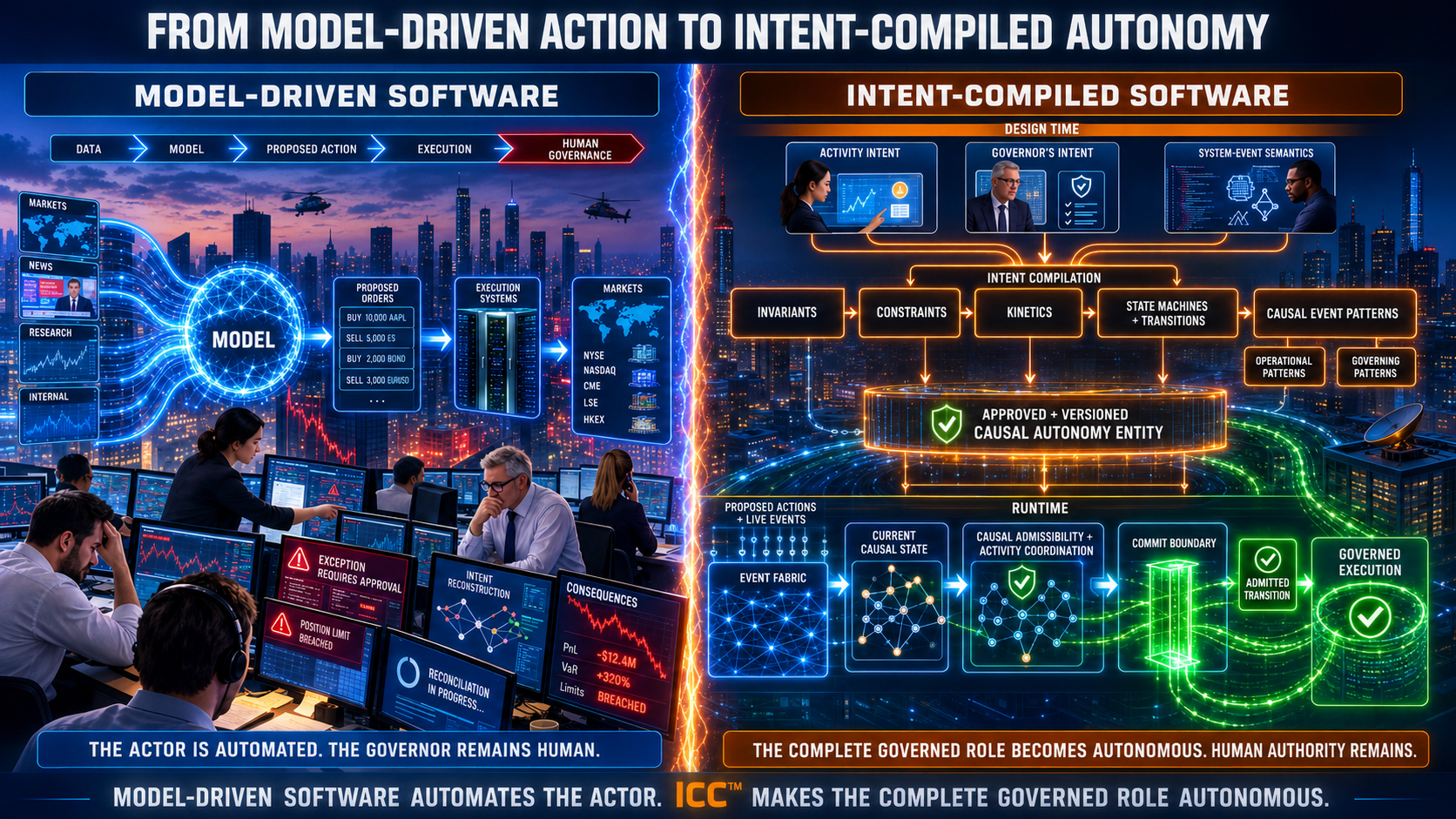
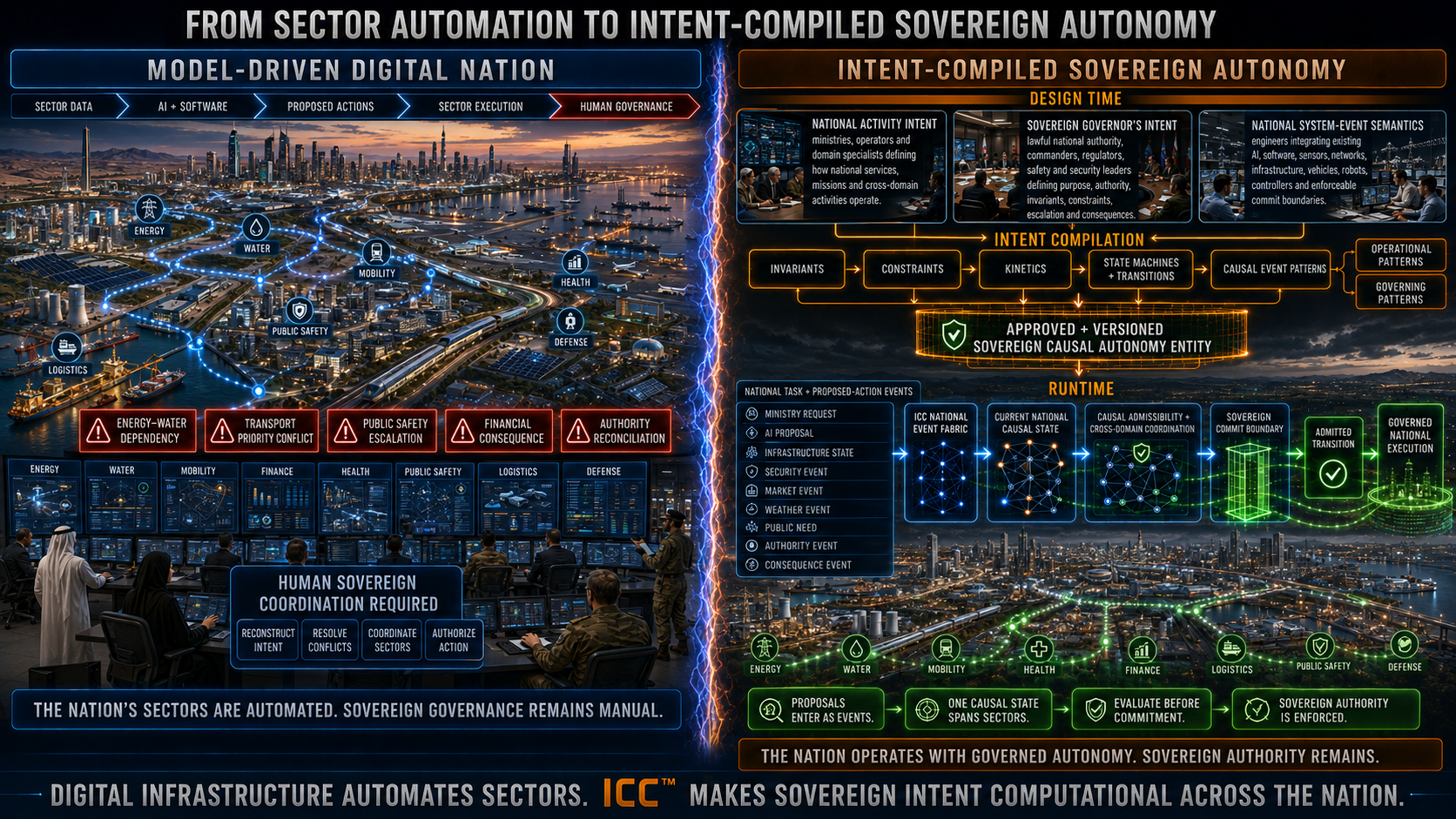
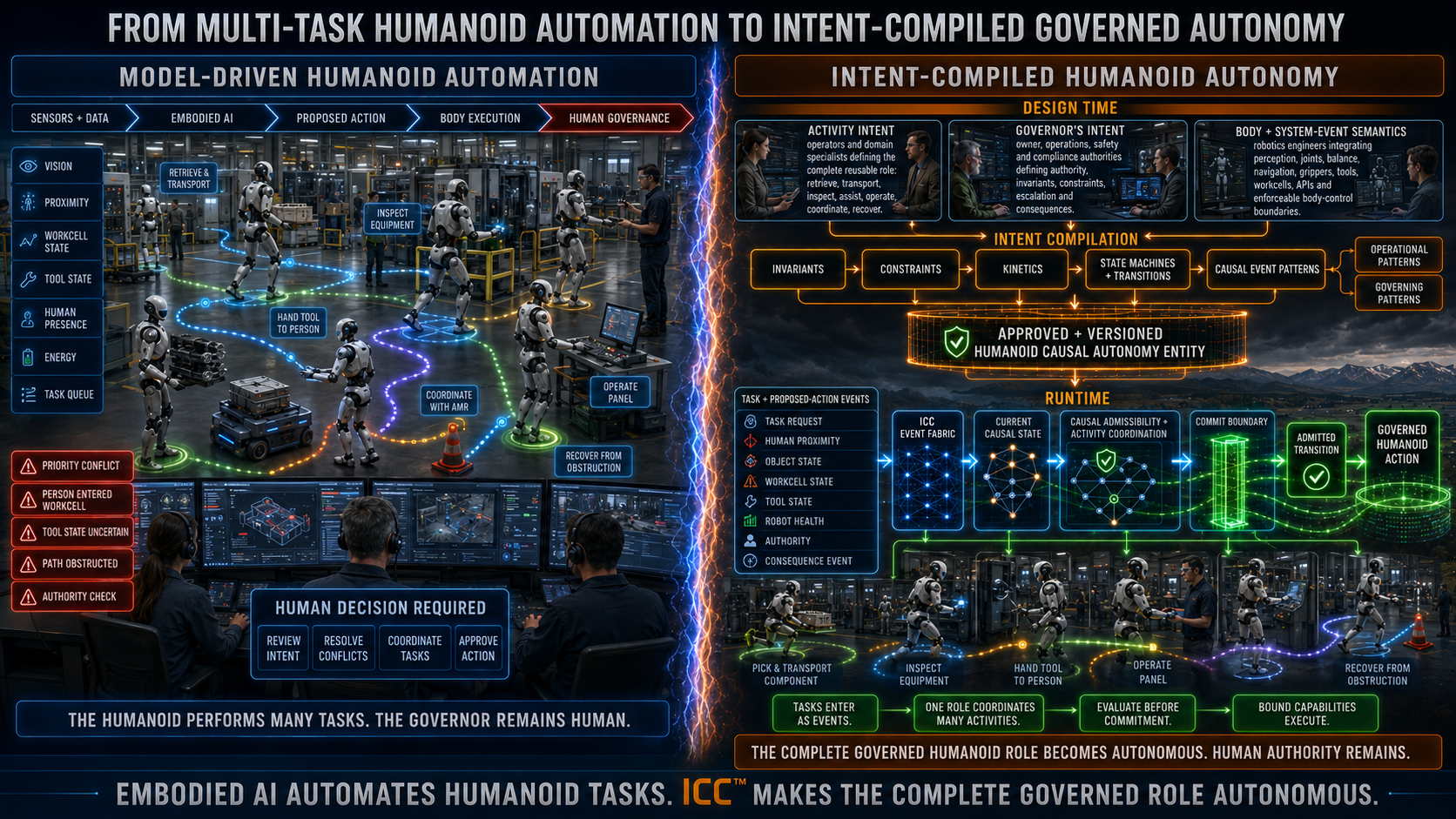
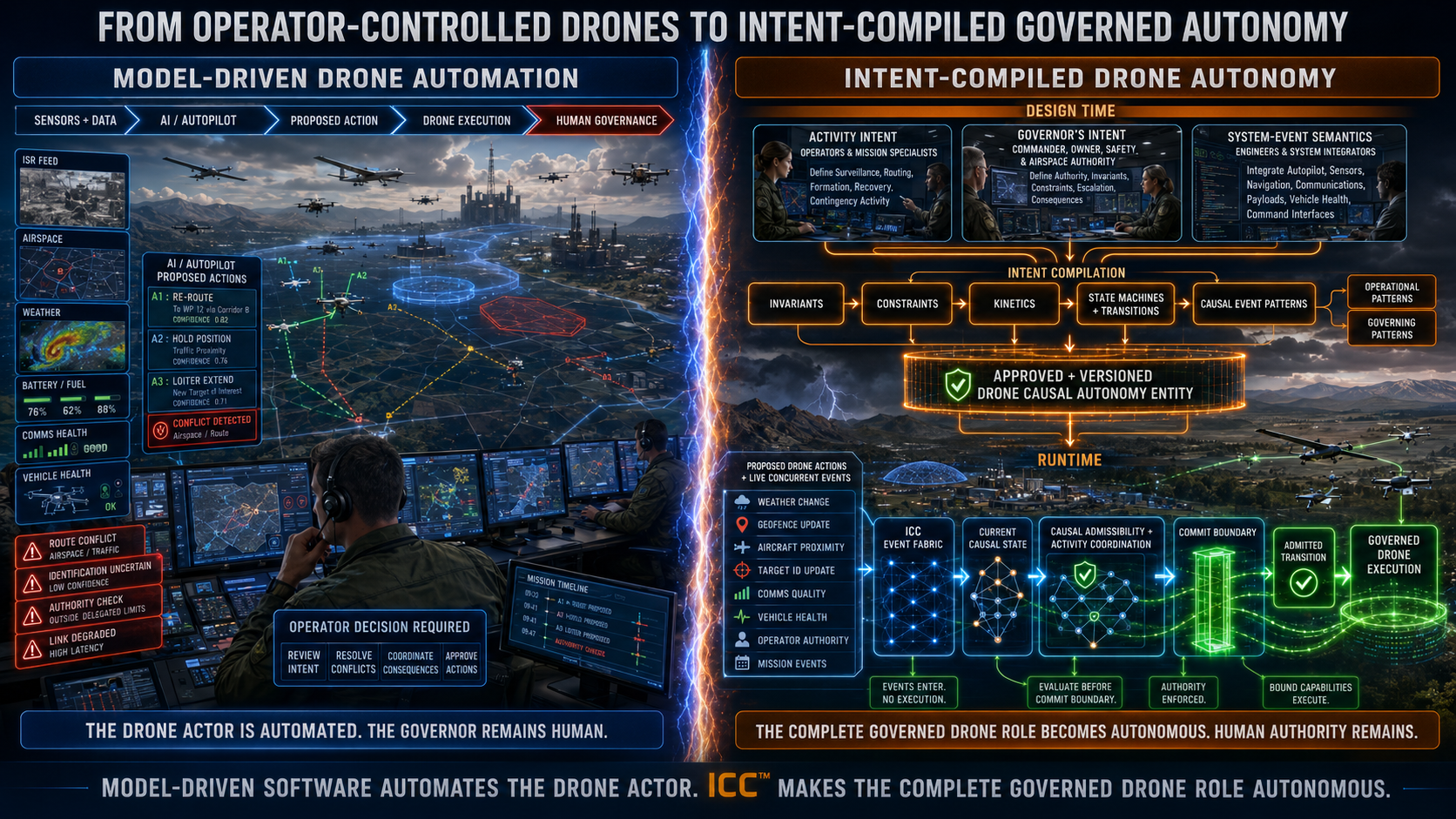
Financial Markets
Intent-Compiled Software — 3:08
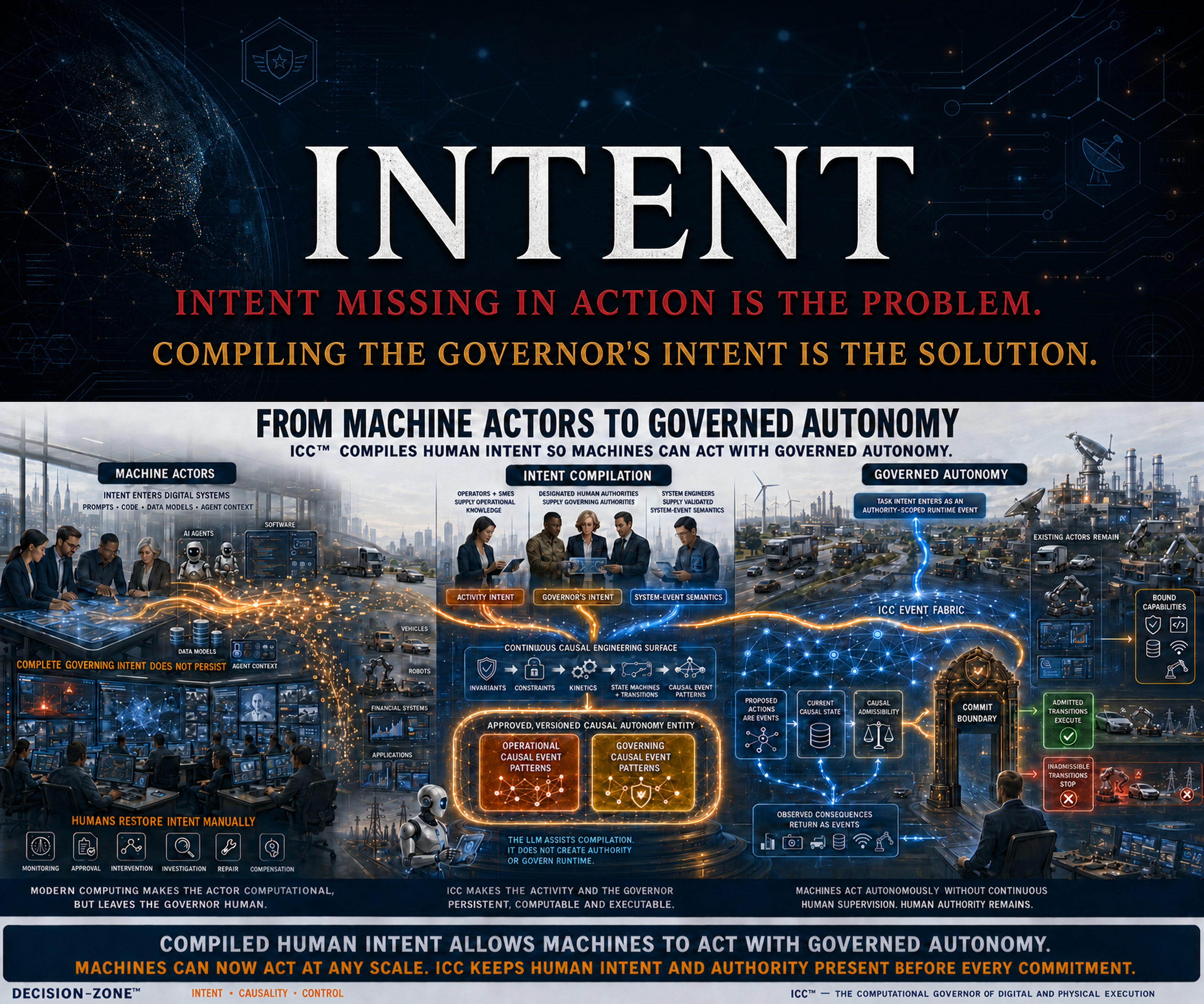 ICC Universal Intent-Compiled Architecture →
The Intent Highlight — 1:01
The Governor Applied — One Architecture, Every Domain
Read the Paper: The Universal Governor →The Governance Ceiling: Business Case →The Investment Case →The Governor — 4:57
Listen Now — Open Access
Podcast 810:16
The Human Governor Made Computable
A strategic briefing on why the human governor must be made computable — and how Decision-Zone achieved it.
Podcast 914:46
The Autonomy Compiler
A spoken essay on why physical autonomy needs a second computation and what that computation is.
Podcast 1010:11
Governed Social Media
A spoken essay on why social media is ungoverned, why distribution at scale is action, and how the ICC governor restores accountability to the feed.
Governed Domains
Decision-Zone Inc. — Runtime Computing